
The Complete Conversion Rate Optimization (CRO) Guide for Businesses in 2026
Master Conversion Rate Optimization (CRO) for your business in 2026. Learn proven strategies to increase leads, boost sales, and turn more website visitors into paying customers with data-driven tactics.
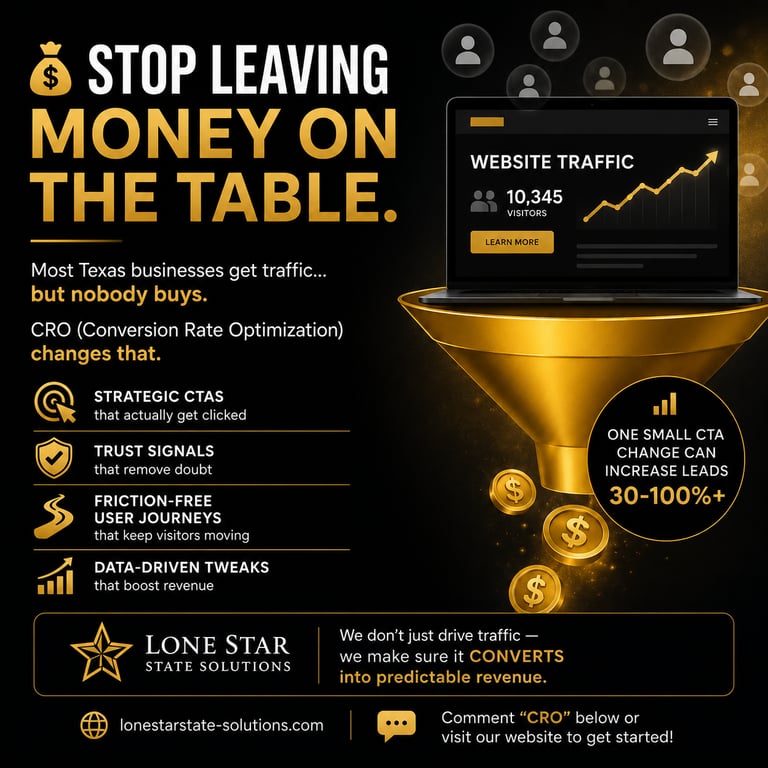
The Complete Conversion Rate Optimization (CRO) Guide for Texas Businesses in 2026
What Is Conversion Rate Optimization (CRO)?
Conversion Rate Optimization is the data-driven practice of improving your website’s performance so that a higher percentage of visitors complete your most important goals (conversions). If you’re a business owner spending time and money to drive traffic to your website — whether through SEO, GEO, Google Ads, or local marketing — but not seeing enough leads, calls, or sales, you’re not alone. Most businesses focus heavily on getting more visitors. Far fewer focus on what happens after someone lands on their site.
That’s where Conversion Rate Optimization (CRO) comes in. CRO is the systematic process of improving your website to increase the percentage of visitors who take a desired action — whether that’s filling out a form, calling your business, booking a consultation, or making a purchase.
In 2026, with rising ad costs, declining organic click-through rates due to AI Overviews, and increasingly impatient buyers, CRO is no longer optional. It’s one of the highest-ROI activities you can invest in. At Lone Star State Solutions, we treat CRO as a core pillar of our integrated Revenue Growth System — combining marketing visibility (SEO + GEO) with sales conversion systems. This guide will show you exactly how to do the same for your business.
Conversion Rate is calculated as: Conversions ÷ Total Visitors × 100
For example: If 1,000 people visit your site and 30 of them fill out a contact form → Your conversion rate is 3%.
The national average for many industries sits between 2–4%. Top-performing sites often achieve 5–10%+ through consistent optimization. CRO is not about tricking people. It’s about removing friction, building trust, and making it easier for the right visitors to take the next step.
Why CRO Matters More Than Ever in 2026 for Texas Businesses.
Here’s the reality many Texas business owners face:
Paid traffic costs continue to rise.
AI search (ChatGPT, Gemini, Perplexity) is reducing traditional clicks.
Buyers are more skeptical and have shorter attention spans.
Competition in home services, roofing, HVAC, construction, law, and professional services is fierce across Texas.
When you improve your conversion rate by even 1–2 percentage points, you can generate significantly more revenue without spending more on traffic.
Realistic impact examples: A 10% improvement in conversion rate can increase revenue by 10% or more (depending on your average order value or lead value).
Many businesses see 20–50%+ lifts in leads or sales after focused CRO work. Better on-site experience also improves SEO and GEO performance because Google and AI engines reward sites that deliver value and keep users engaged.
In short: Traffic without conversion is just expensive noise.
How CRO Fits Into Your Complete Revenue Growth System
At Lone Star State Solutions, we don’t treat marketing and sales as separate functions.
We build one connected system:
SEO + GEO → Get Found & Get Trusted in search & AI
Content & Lead Generation → Attract qualified visitors
CRO & Sales Systems → Convert visitors into customers
CRO acts as the bridge between visibility and revenue. Even the best GEO-optimized content won’t generate results if your website creates friction or fails to build trust.
The CRO Process: A Step-by-Step Framework
Research & Data Collection
Analyze current analytics (Google Analytics 4, heatmaps, session recordings)
Identify high-traffic, low-conversion pages
Gather user feedback (surveys, interviews, support tickets)
Hypothesis Creation
Form clear, testable hypotheses based on data
Example: “Simplifying our contact form from 8 fields to 4 will increase form submissions by 25% because it reduces friction.”
Prioritization: Use frameworks like PIE (Potential, Importance, Ease) or ICE to decide what to test first.
Testing & Implementation: Run A/B tests or multivariate tests
Implement winning variations
Analysis & Iteration
Measure results
Learn and apply insights to future tests
This is not a one-time project — it’s an ongoing growth engine.
Key Areas to Optimize for Maximum Conversions
Page Speed & Core Web Vitals
Slow websites kill conversions. Even a 1-second delay can reduce conversions by 7–10%.
Prioritize: Image optimization, caching, fast hosting, and minimizing unnecessary scripts.
Mobile Experience
Over 60% of website traffic in many industries is now mobile. Texas users are often on the go.
Ensure responsive design, fast loading on mobile, and thumb-friendly buttons.
Clear Value Proposition & Headlines]
Visitors should understand what you do and why they should care within 5 seconds.
Use benefit-focused headlines, not just feature lists.
Credibility
Customer testimonials and reviews
Case studies with results
Trust badges, certifications, and security seals
Professional design and clean layout
“As seen in” or media mentions (when applicable)
Compelling Calls-to-Action (CTAs) This is one of the highest-leverage areas. Strong CTAs are:
Clear and benefit-oriented (“Get Your Free Roof Inspection” vs. “Submit”)
Action-oriented with strong verbs
Visually prominent (color contrast, size, placement)
Low-friction where possible (“Book a 15-Minute Call” instead of long forms)
Test different CTA copy, colors, placement (above the fold vs. after content), and button text.6. Form OptimizationLong forms kill conversions. Only ask for information you truly need
Use smart defaults and progressive profiling
Add helpful inline validation and error messages
Consider multi-step forms for complex services
User Experience & Navigation
Make it easy for visitors to find what they need. Intuitive menu structure
Clear information hierarchy
Helpful internal linking
Prominent contact options (phone, chat, form)
Personalization & AI-Assisted Experiences (2026 Trend)
Use AI tools to show relevant content, offers, or recommendations based on visitor behavior, location, or referral source. Personalization can significantly lift conversions when done right.
Common CRO Mistakes Businesses Make
Focusing only on design/aesthetics instead of data
Running tests without enough traffic (results aren’t statistically significant)
Ignoring mobile users
Using generic CTAs (“Learn More”, “Click Here”)
Adding too many distractions or pop-ups
Not tracking the right metrics (vanity metrics vs. revenue metrics)
Treating CRO as a one-time project instead of ongoing
Recommended Tools for CRO in 2026
Analytics: Google Analytics 4
Heatmaps & Recordings: Microsoft Clarity (free), Hotjar
A/B Testing: Google Optimize (sunset), VWO, Optimizely, or built-in Webflow/Framer testing
Form Tools: Typeform, Gravity Forms, or native builder forms
Speed Testing: Google PageSpeed Insights, GTmetrix
User Testing: UserTesting.com or simple surveys
Actionable CRO Checklist for Texas Businesses
Audit your top 5 pages for speed and mobile experience
Review and strengthen all CTAs (make them benefit-driven)
Simplify your main contact/lead forms
Add or improve trust signals and testimonials
Set up heatmap and session recording tools
Create a prioritized list of tests for the next 90 days
Define clear conversion goals in your analytics
Review your value proposition — is it crystal clear?
Final Thoughts: CRO as a Competitive Advantage
In today’s competitive market, the businesses that win are not always the ones with the most traffic. They’re the ones who convert the traffic they already have more effectively. Conversion Rate Optimization is one of the highest-leverage investments you can make. It compounds over time and directly impacts your bottom line. When you combine strong SEO + GEO visibility with excellent CRO and integrated sales systems, you create a true Revenue Growth Engine. At Lone Star State Solutions, we help Texas businesses build exactly this — one connected system that attracts qualified visitors and turns them into loyal customers.

Lone Star State Solutions
We help businesses increase online visibility, generate qualified leads, improve sales performance, and accelerate revenue growth through AI Search Visibility (SEO + GEO), digital marketing, and data-driven strategies.
© 2026 Lone Star State Solutions, LLC • Serving Businesses Across Texas & the United States
Explore Our Services
Tell us about your business and we'll reach out with a personalized growth strategy.
Contact Us
(903) 309-3684
contact@lonestarstate-solutions.com